
Key takeaways
It's biology, not effort
After 40, declining estrogen disrupts GLP-1 production, muscle preservation, insulin sensitivity, and sleep — making the calorie math less reliable.
The tools changed, not you
The same food intake that maintained weight at 35 can produce gradual gain at 42 because what your body does with food has changed.
GLP-1 addresses the root cause
GLP-1 medications restore the appetite and blood sugar signaling that perimenopause suppresses — working with biology instead of against it.
This article is for educational purposes only and is not a substitute for professional medical advice. A licensed clinician can determine whether treatment is appropriate for you.
The quick answer
After 40, hormonal changes — primarily declining estrogen — reduce natural GLP-1 production, accelerate muscle loss, worsen insulin resistance, and disrupt the sleep that regulates appetite hormones. These shifts make the calorie-in-calorie-out equation less accurate than it used to be. GLP-1 medications work by restoring the appetite and blood sugar signaling that these hormonal changes disrupt.
If you've been eating the same way you always have and suddenly gaining weight, or cutting calories and seeing almost nothing change, or exercising more than ever and still losing ground — you're not imagining it. Something did change. It changed in your 40s, it's hormonal, and it has a specific explanation. The frustrating part isn't just the weight. It's that the tools that used to work have stopped working, and no one has explained why. This post is that explanation.
The hormone driving more than you realize
Estrogen is usually talked about in the context of menstrual cycles and menopause symptoms. What gets less attention is how much it does for metabolism. Estrogen directly supports the production of GLP-1, a gut hormone that signals fullness to the brain and keeps blood sugar stable after meals. It helps maintain muscle mass by supporting protein synthesis. It improves insulin sensitivity in muscle, liver, and pancreatic tissue. And it regulates the cortisol stress response, keeping the body from overreacting to everyday stressors with a fat-storage signal. In perimenopause — which can begin anywhere from the late 30s to the mid-40s, often years before periods stop — estrogen starts to fluctuate and gradually decline. None of those downstream functions go away cleanly. They get noisier, less consistent, and less effective.
What that means for appetite
GLP-1 is the hormone that makes you feel satisfied after a meal and keeps that fullness lasting long enough to make it to the next one. When estrogen supports GLP-1 production well, appetite regulates almost automatically. You eat, GLP-1 rises, you feel full, you stop. When estrogen starts declining, natural GLP-1 production drops with it. Fullness signals come in weaker and fade faster. Hunger arrives sooner. Cravings — particularly for carbohydrates, which produce quick blood sugar responses — become more persistent. And because this happens gradually over years, it can feel like your relationship with food has just changed, rather than recognizing it as a hormonal shift.
What that means for metabolism
Muscle is the primary driver of resting metabolic rate — how many calories your body burns just to sustain itself at rest. Estrogen has direct muscle-preserving effects, and when it declines, muscle loss accelerates. Not dramatically at first, but consistently. A 3 to 8 percent reduction in muscle mass per decade after 30 is the baseline for most people. Perimenopause accelerates this. Less muscle means a lower resting burn. Which means the same food intake that maintained weight at 35 produces gradual gain at 42. Not because anything changed in what you're eating. Because what your body does with what you eat has changed. Calorie restriction on top of this accelerates the problem. Eating less without enough protein causes more lean mass loss, which lowers metabolic rate further, which makes the calorie math worse. Many women have been in this loop for years without realizing the hormone shift created it.
What that means for sleep — and why sleep matters for weight
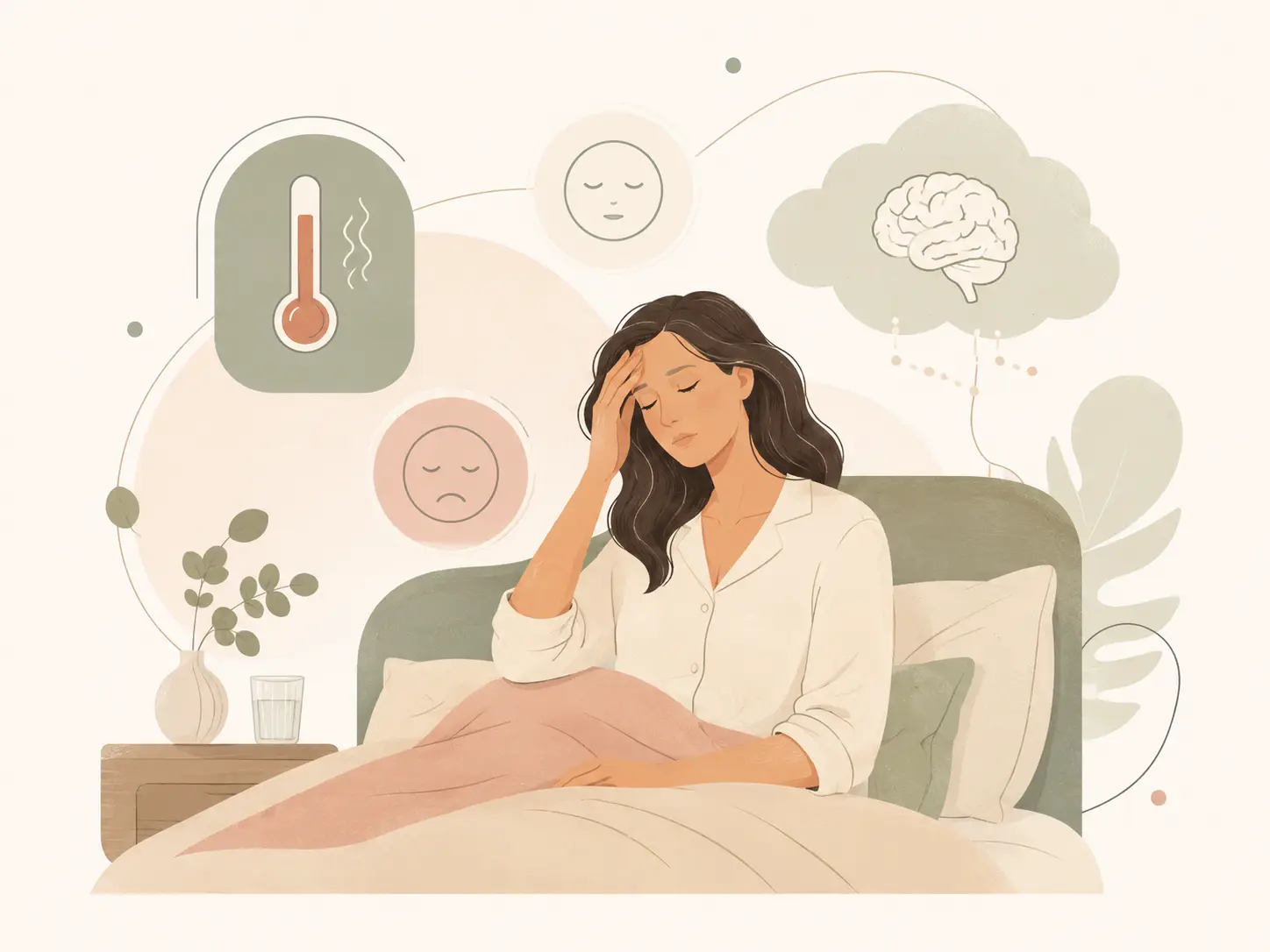
Hot flashes and night sweats are vasomotor symptoms caused by the same estrogen fluctuation driving everything else. About 75 percent of women going through perimenopause experience them. Each one triggers a cortisol release, and repeated sleep disruption from night sweats keeps cortisol chronically elevated overnight. Even two days of disrupted sleep produces measurable increases in ghrelin, the hunger hormone, and decreases in leptin, the fullness hormone, alongside worsened insulin sensitivity. For women who have been waking up repeatedly from night sweats for months or years, this is a sustained metabolic stressor layered on top of everything else. More hunger, less fullness, poorer blood sugar regulation — even before the day starts.
Why GLP-1 medications address the actual problem
GLP-1 medications — semaglutide and tirzepatide are the most widely used — work by mimicking and amplifying the gut hormone that perimenopause suppresses. They restore the fullness signaling that estrogen decline weakened. They stabilize blood sugar, reducing the cravings driven by insulin resistance. They slow gastric emptying so meals produce longer-lasting satisfaction. This is why GLP-1 medications feel different from dieting for most women who take them. Dieting fights against a hormonal environment that's pushing back. GLP-1 medications work with the biology — they restore a signaling system that the hormonal changes of your 40s disrupted. Clinical trials show average weight loss of 15 percent for semaglutide over 68 weeks, and 20 to 22 percent for tirzepatide — results that far exceed what lifestyle intervention alone typically produces. The difference is that GLP-1 medications address the appetite and blood sugar dysregulation at its source, making the dietary changes that always mattered easier to sustain.
What works alongside the medication
GLP-1 medications are most effective as part of a broader approach. Resistance training preserves and builds the lean mass that keeps resting metabolic rate from dropping further — and estrogen's decline makes this more important, not less. Adequate protein intake, 1.2 to 1.6 grams per kilogram of body weight daily, prevents the muscle loss that can accompany rapid weight reduction. Sleep quality matters too — the vasomotor symptoms of perimenopause disrupt sleep in ways that raise cortisol and hunger hormones overnight, and treating those symptoms through whatever approach is right for you removes a real metabolic headwind. None of this is complicated. It's just that each piece matters more in your 40s than it did before, because the hormonal environment that used to compensate for gaps no longer does.
The point
Diets didn't stop working because you stopped trying. They stopped working because the hormonal environment that made them work changed. GLP-1 medications exist because biology is treatable. If you've been doing everything right and not getting the results that should follow from it, a hormonal evaluation is a logical place to start.
At Coivas
If you're in your 40s and feeling like your body has stopped responding the way it used to, Coivas is a telehealth provider focused on women's metabolic and hormonal health. GLP-1 medications are one of the tools we work with. Get started today at Coivas.com.
Coming up next
Related: if you're already on a GLP-1 medication and wondering why your results are slower than the clinical trial numbers suggest, the next post covers the most common reasons — and the one factor most providers skip.
Common questions
Answers to the questions women ask most often when diets and exercise stop producing the results they used to.
Declining estrogen reduces natural GLP-1 production (making hunger harder to regulate), accelerates muscle loss (lowering resting metabolic rate), and worsens insulin resistance. The same calorie deficit that worked at 30 produces less result at 40 because the hormonal environment supporting metabolism has changed.
Your resting metabolic rate has likely dropped due to muscle loss accelerated by declining estrogen. Lower muscle mass means the body burns fewer calories at rest, so the same food intake produces weight gain. This is a physiological change, not a behavioral one.
Yes. GLP-1 medications restore the appetite and blood sugar regulation that perimenopause and menopause disrupt. They work by mimicking a gut hormone that declines alongside estrogen. Clinical trials show 15–22% average body weight loss depending on the medication.
Perimenopause reduces estrogen, which supports GLP-1 production, muscle preservation, insulin sensitivity, and sleep regulation. When estrogen fluctuates and drops, all of these systems are affected simultaneously — which is why weight gain in the 40s often feels sudden and resistant to the usual approaches.
Related reads


Sources
This article draws on clinical research on hormonal changes in perimenopause, GLP-1 medications, and metabolic health.
- Hurtado MD, et al. Weight loss response to semaglutide in postmenopausal women with and without hormone therapy use. Menopause. 2024;31(4):266-274.
- Wilding JPH, et al. Once-weekly semaglutide in adults with overweight or obesity. N Engl J Med. 2021;384:989-1002.
- Jastreboff AM, et al. Tirzepatide once weekly for the treatment of obesity. N Engl J Med. 2022;387:205-216.
- Lovejoy JC, et al. Increased visceral fat and decreased energy expenditure during the menopausal transition. Int J Obes. 2008;32:949-958.
- Spiegel K, et al. Sleep curtailment in healthy young men is associated with decreased leptin levels, elevated ghrelin levels, and increased hunger. Annals of Internal Medicine. 2004;141:846-850.
- Doherty TJ. Invited review: aging and sarcopenia. J Appl Physiol. 2003;95:1717-1727.
- Mauvais-Jarvis F, et al. Menopausal hormone therapy and type 2 diabetes prevention: evidence, mechanisms, and clinical implications. Endocrine Reviews. 2017;38(3):173-188.